
Table of Contents
- How to Choose the Best Essential Oils for Skincare
- How to Dilute Essential Oils for Face Without Irritation
- Carrier Oils for Skincare: The Base That Makes It Work
- Essential Oil Safety and TGA Guidelines You Need to Know
- Which Essential Oils Suit Acne-Prone and Sensitive Skin
- Common Mistakes When Using Essential Oils on Skin
- Conclusion
- Frequently Asked Questions
Last Updated: September 11, 2026
How to Choose the Best Essential Oils for Skincare
Choosing the best essential oils for skincare starts with matching the oil to your specific skin concern, then verifying purity on the label.
Essential oils for skincare are concentrated plant extracts that carry the therapeutic properties of their source botanicals. They are not fragrances. That distinction matters, because a fragrance oil and a pure essential oil can smell identical while behaving completely differently on your skin.
The Therapeutic Goods Administration's guidance on listed medicines sets out how therapeutic claims for complementary medicines are regulated, which affects what a supplier can legally say about their oils.
Get the oil-to-concern match wrong and nothing else in your routine will fix it.
Match the Oil to Your Skin Concern
Different oils do different jobs. A common mistake is treating them as interchangeable.
- Dry or mature skin: rose, geranium, sandalwood, frankincense
- Oily or congested skin: tea tree, lemon, eucalyptus, rosemary
- Redness or reactivity: chamomile, lavender, blue tansy
- Dull or uneven tone: neroli, carrot seed, sweet orange
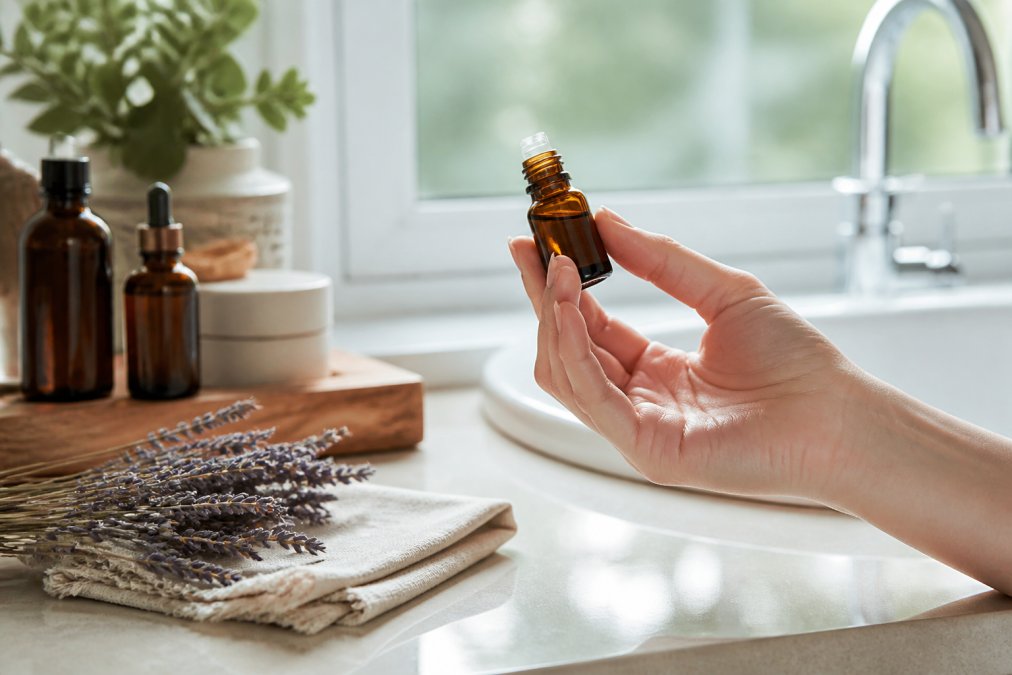
What to Check on the Label
Look for the botanical Latin name, the plant part used, and the country of origin. A label reading "lavender fragrance" tells you nothing. A label reading Lavandula angustifolia, flower, steam-distilled, gives you something to verify.
What most guides miss is that "pure" is not a regulated term on a bottle. It's a marketing word until the supplier backs it with documentation.
How to Dilute Essential Oils for Face Without Irritation
Learning how to dilute essential oils for the face is the single most important safety step, because undiluted oils can cause chemical burns and lasting sensitisation. The correct approach is to measure essential oil as a percentage of your total carrier volume, then blend thoroughly before applying.
For facial use, most practitioners work between 0.5% and 1% dilution (naha.org). That's conservative by design. Facial skin is thinner than the skin on your body and absorbs more readily.
Dilution Ratios by Skin Type
| Skin Type | Dilution | Drops per 10 ml Carrier | Notes |
|---|---|---|---|
| Sensitive or reactive | 0.25-0.5% | 1-2 drops | Patch test first, always |
| Normal | 1% | 4 drops | Standard facial blend |
| Oily or blemish-prone | 1-1.5% | 4-6 drops | Avoid over-drying |
| Mature or dry | 1% | 4 drops | Pair with richer carrier |
Mixing a Simple Facial Blend
Start with a 10 ml amber glass bottle. Add 10 ml of jojoba or rosehip carrier oil, then 4 drops of essential oil total. Cap it and roll between your palms for thirty seconds to combine.
Label the bottle with the date and the oils used.
Carrier Oils for Skincare: The Base That Makes It Work
Carrier oils for skincare do more than dilute. They carry the essential oil across the skin barrier, and the one you choose changes how the finished blend feels and performs.
Jojoba is the closest match to human sebum, which makes it a sensible default for most faces. Rosehip is lighter and suits those wanting a faster-absorbing finish. Sweet almond is affordable and works well for body blends, though anyone with a nut allergy should avoid it.
What most guides skip: carrier oils oxidise. A bottle that's been open on a sunny shelf for a year has gone rancid, and rancid oil will irritate skin regardless of what you've blended into it.
Essential Oil Safety and TGA Guidelines You Need to Know
Essential oil safety and TGA guidelines exist because these are potent concentrates, not gentle waters. The TGA's information on complementary medicine regulation explains how therapeutic goods are assessed and listed in this market, and it's worth reading before you make any health claim about a blend you've made.
Phototoxic oils are the ones most people get caught by. Bergamot, lime, lemon, and grapefruit expressed from the peel can make skin dramatically more sensitive to sunlight. If you're using them, do it at night.
Other rules worth keeping:
- Never ingest essential oils unless a qualified practitioner directs it
- Keep oils away from the eyes, mucous membranes, and broken skin
- Store out of reach of children
- Stop use immediately if you notice burning, itching, or swelling
Patch Testing Before You Commit
Apply a small amount of your diluted blend to the inner forearm. Wait 24 hours. If there's no redness, itching, or swelling, the blend is likely safe for you.
This is not a formality. Sensitisation can develop after repeated exposure to an oil you previously tolerated, so retest any new batch.
Which Essential Oils Suit Acne-Prone and Sensitive Skin
For acne-prone skin, tea tree and eucalyptus are the usual starting points because they're well tolerated at low dilution. For sensitive skin, chamomile and lavender are gentler choices.
Here's the part that trips people up: "natural" does not mean "non-irritating." Some of the most reactive essential oils, including cinnamon, clove, and oregano, are entirely natural. They're simply too strong for facial use at anything approaching a normal dilution.
If your skin is genuinely reactive, start with a single oil at 0.25% and add nothing else for two weeks. Introducing three oils at once tells you nothing when something goes wrong.
Common Mistakes When Using Essential Oils on Skin
The biggest mistake is skipping dilution because a recipe online said "a few drops." A few drops into what volume? Without that number, the instruction is meaningless.
The second is buying on scent alone. Smell tells you nothing about purity, origin, or how the oil will behave on skin.
The third is assuming more oil means faster results. It doesn't. Above roughly 1% for facial use, you're increasing irritation risk without adding benefit.
The fourth is storing blends in clear glass on a windowsill. Light degrades essential oils and accelerates carrier oxidation. Amber glass in a cool cupboard is the standard for a reason.
Conclusion
Getting skincare right with essential oils comes down to three things: matching the oil to your concern, diluting properly, and sourcing from a supplier who can prove what's in the bottle.
Australian Oils of Nature supplies 100% pure essential oils, sustainably sourced and Australian made, with no additives, preservatives, or fillers. Every batch is chemical free, so what you blend is what you get.
If you want oils you can trust for facial blends, massage work, or your own formulations, browse the range and start with a single oil. Get started with Australian Oils of Nature.
Frequently Asked Questions
Which essential oils are safe for facial skin?
Lavender, frankincense, tea tree, and geranium are commonly used on facial skin when properly diluted. Lavender and frankincense suit most skin types, while tea tree is often chosen for breakout-prone areas. Citrus oils such as bergamot and lemon are phototoxic, meaning they can cause reactions when skin is exposed to sunlight, so use them at night or avoid them on the face. Always dilute to 1-2% for facial use and patch test before applying to larger areas.
How do I properly dilute essential oils for skincare?
For facial skincare, dilute to 1% for sensitive skin (about 6 drops per 30ml of carrier oil) and up to 2% for normal skin (about 12 drops per 30ml). For body products, 2-3% is typical. Always add essential oils to the carrier oil, never the reverse, and stir gently rather than shaking. Store blends in dark glass bottles away from heat and sunlight, and use within three months for the freshest results.
What are the risks of using essential oils on the skin?
Undiluted essential oils can cause burns, redness, and sensitisation, particularly citrus, cinnamon, oregano, and clove oils. Some people develop allergic contact dermatitis after repeated exposure, even to oils they previously tolerated. Phototoxic oils increase sunburn risk for up to 18 hours after application. Essential oils are not regulated as medicines for skin conditions, so they should not replace prescribed treatment for eczema, psoriasis, or infections.
Are essential oils regulated for safety in skincare?
In Australia, the TGA regulates essential oils as therapeutic goods only when they carry therapeutic claims, such as treating a skin condition. Oils sold for cosmetic or aromatic use fall under different rules and do not require the same pre-market assessment. This means quality varies between suppliers. Look for oils labelled 100% pure with no added fillers, and check whether the supplier provides batch documentation or purity testing on request.